


Looking Vertically
The credit union crossroads

Credit unions have spent more than a century building something most financial institutions can’t buy: a reputation for putting people before profit. Founded to serve communities that traditional banks ignored, they grew on trust, accessibility, and a member-owned model that made the relationship personal.
That history still matters. It’s just no longer enough.
Since 2010, the number of U.S. credit unions has dropped by nearly 40%, as technology, cybersecurity, compliance, and talent costs climb faster than most institutions can keep pace with. Meanwhile, roughly three-quarters of consumers now expect digital-first banking as a baseline expectation, not a feature. Membership growth has slipped to about 1.9% annually — near historic lows — and the generational math is unkind: the median member is roughly a decade older than they were fifteen years ago, while nearly 60% of Gen Z already does its everyday banking through fintech.
Credit unions haven’t lost what made them work. They’ve lost the exclusive rights to it. Local, trusted, member-first — every fintech and neobank now claims the same ground, often with a better app. The competitive set isn’t other credit unions anymore. It’s Chase and Chime and Robinhood, all judged by the same standard: does this feel as good as the best digital experience I had today, financial or otherwise?
Here’s what’s promising: trust, community ties, and a genuine reason for being are not commodities. Banks can’t manufacture them, and fintechs haven’t earned them. The credit unions that win the next decade won’t trade those strengths for shinier ones, but put them to work harder than anyone else is willing to.
We see five shifts defining that work.
“Credit unions haven't lost what made them work. They've lost the exclusive rights to it.”
Member ownership is still one of the most genuinely distinctive things in financial services. It’s also become wallpaper — a phrase members nod past on their way to checking their balance.
The problem is that ownership, while true, remains largely unfelt. Nobody picks a financial institution because they admire its governance structure; they pick it because of what happens when they need something. The onus is on Credit Unions to explain why ‘ownership’ is better for the member sitting across the desk—or, more likely, staring at a phone screen.
Look outside the category for proof of what this can look like: Costco has made membership legible in a way no financial brand has matched. Every pricing decision, every product call, every $1.50 hot dog that hasn’t moved since 1985 is a visible argument for whose side the company is on. Credit unions have the structural advantage Costco had to manufacture. The opportunity is turning “member-owned” from a claim into something members can actually point to.

Trust has been the category’s calling card for decades: the friendlier, more human option next to the big bank down the street. That is both an asset and a ceiling. Being the alternative to something is still defining yourself in relation to it — and a marketplace full of confident, fast-moving challengers doesn’t reward institutions that lead with “at least we’re not the big bank.”
Wealthfront offers a useful model of what that confidence sounds like. It has a great product, sure, but it also has the posture. 'Money works better here’ is a powerful claim, stated plainly and backed up at every touchpoint, from the app to the billboard. Credit unions have earned the right to that same level of confidence. They just need to say it like they mean it.
Local roots are real and they matter — they’re the reason a member trusts the person on the other end of the phone. But “local” used to be shorthand for convenience, and that shorthand has expired. Convenience now means available everywhere, instantly, without a branch in sight.
This creates a trap: the same qualities that make a credit union feel personal can make it feel small. State Farm has spent decades solving exactly this problem without abandoning its neighborhood-agent model — it just built the infrastructure, claims systems, and brand presence to make “local” and “everywhere” the same promise instead of competing ones. Credit unions have the same opening: shared branching, digital infrastructure, and a brand system strong enough to travel, ultimately making “rooted or reachable?” a false choice.
“Relationship banking” has quietly come to mean friendly service — a smile at the branch, a name remembered. That’s nice. But it’s not what people actually need when they’re trying to buy a house, pay down debt, or figure out retirement.
SoFi is a useful reference point for the difference between service and genuine advice. Its advantage isn’t simply that it presents itself as approachable or member-friendly. It brings together access to CFP professionals, budgeting and net-worth tracking, goal-based savings tools, educational resources, and AI-powered planning to make guidance specific and actionable.
Credit unions have spent decades building the trust that advisory relationships depend on — they’ve just mostly applied it to service rather than substance. The opportunity is to use that trust to help members understand their full financial picture, make better decisions, and turn everyday interactions into meaningful progress. The shift from friendly to useful is where the real differentiation lives, and where products stop being commodities the moment guidance enters the picture.

Rates still matter. They’re also the easiest thing for a competitor to match, the first thing a promotion erases, and the hardest thing for a member to actually feel six months later.
What people care about is what the rate gets them: the house, the debt paid off, the savings cushion, the version of their life that felt out of reach a year ago. Stripe figured this out for a totally different category — it doesn’t sell payments processing, it sells revenue growth. Credit unions have the same reframe available. Compete on progress instead of pricing, and the conversation changes from “can you beat this APR” to “can you get me there faster” — a much better fight to be in, and one credit unions are better positioned to win.
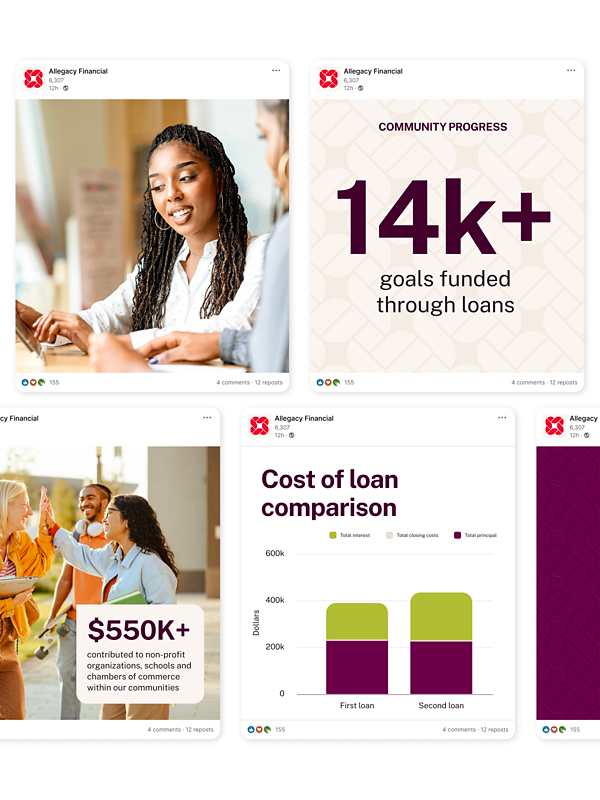
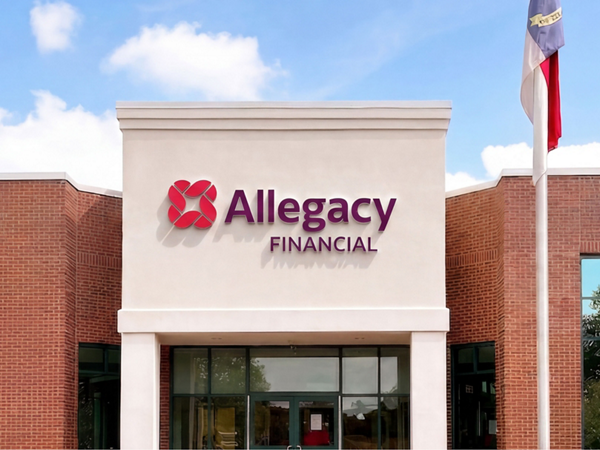
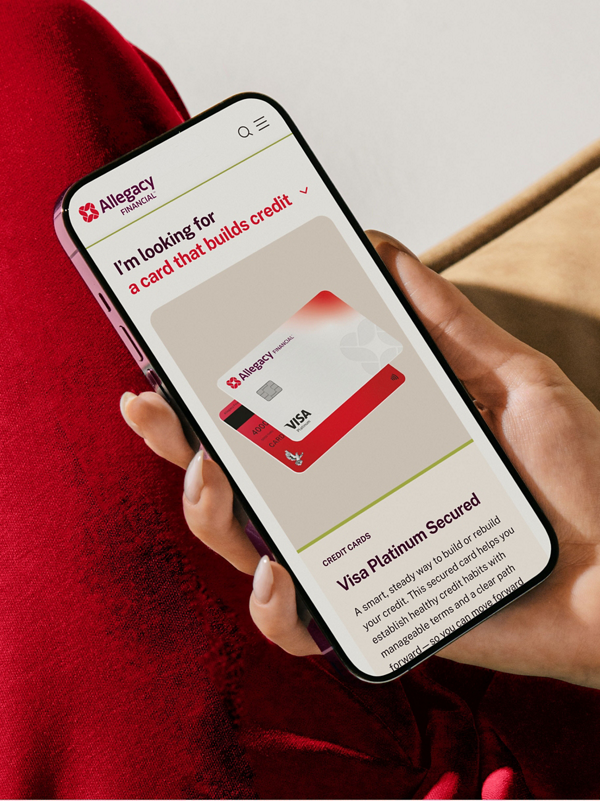
Allegacy Financial illustrates what it takes for a credit union to evolve without leaving its heritage behind. As member expectations shifted and the organization expanded beyond the traditional boundaries of a credit union, Allegacy needed a brand that reflected not only what it offered, but why it mattered. Lippincott helped reposition the organization around its greatest competitive advantage: the trusted relationships it had spent decades earning.
From a new name and identity to a redesigned digital experience, AI-ready content strategy, and the positioning Where roots and relationships matter™, every element worked together to express Allegacy as a modern financial partner while preserving the warmth, trust, and community connection that set it apart.
None of this gets easier. Competition will keep widening, expectations will keep climbing, and technology will keep raising the bar on what “good enough” means.
But the answer was never going to be choosing between heritage and reinvention. It’s bringing both to the same table — member-owned and member-obsessed, trusted and confident, local and everywhere, relationship-driven and genuinely useful, competitive on rates and unmistakable on outcome.
They’re the same ones the movement was built on, asked to show up with more rigor. For the credit unions willing to make that case — not just claim it — the future isn’t a threat to relevance. It’s the best shot at earning it back.


