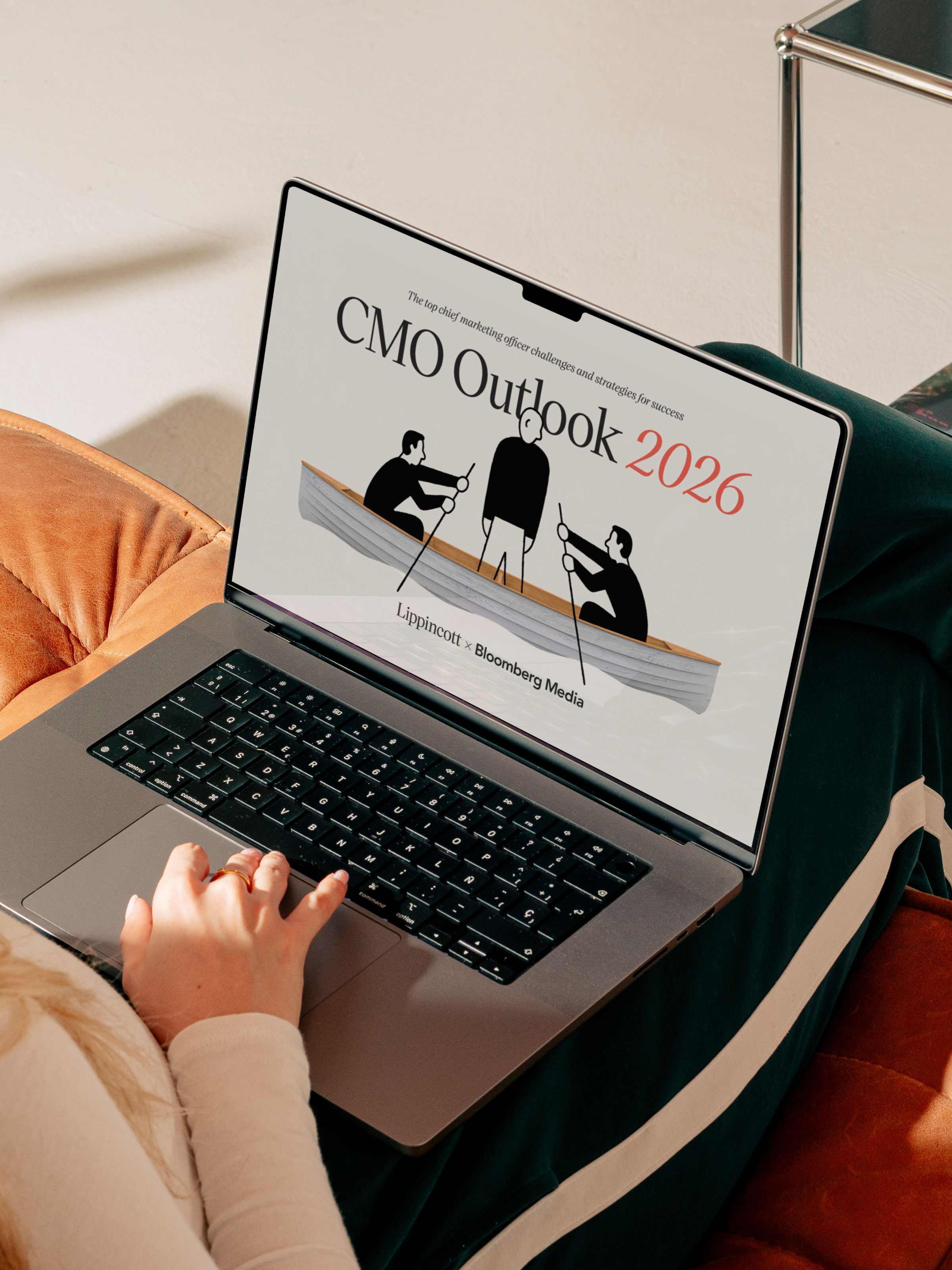
CMO Outlook 2026

A global study of 500+ CMOs on the key challenges and competing forces shaping modern marketing leadership

Findings at-a-glance

  • CMOs are actively deprioritizing the long-term brand-building initiatives they believe are critical for future growth, favoring short-term performance outcomes that strengthen internal credibility and influence. 
  • Organizational alignment is the hidden driver of marketing effectiveness. Across growth, AI adoption, measurement, and cultural relevance, stakeholder alignment emerges as an undervalued lever for unlocking marketing performance. 
  • As marketers accelerate investment in AI implementation, many are shifting resources away from websites, user experience, thought leadership content, and loyalty programs—the very brand and experience foundations that increasingly shape AI discoverability and recommendation. 
  • Cultural relevance has become an operational challenge as much as a creative one. Slow decision-making, fragmented governance, and organizational complexity often prevent brands from responding to culture at the speed required.

Much has been written about the changing role of the chief marketing officer, with new studies and reports seemingly appearing every few weeks, each attempting to define the pressures CMOs face and how the role is evolving.

This report brings a different perspective to that conversation. Drawing on insights from a global study of 500+ marketing leaders, it explores the challenges shaping modern marketing leadership today – from AI disruption and organizational friction to growth pressure, measurement demands, and culture-driven marketing. 

Rather than viewing these challenges in isolation, the report looks closely at each one individually before connecting the dots to interrogate: 

  • Why marketing leaders are struggling to balance growth and brand

  • The hidden organizational barriers slowing innovation

  • What separates empowered CMOs from constrained ones

  • Five imperatives for future-ready marketing leadership

Taken together, these findings paint a more nuanced picture of the modern CMO experience – one that is more commercially accountable than ever, but also more constrained. The issue is less about whether marketing leaders understand what needs to be done and more about whether their organizations create the conditions required to do it. 
 
Ultimately, the report aims to help marketers see their challenges differently and better understand the conditions shaping their ability to succeed.

Methodology

Designed in partnership with Bloomberg Media, and fielded by NewtonX, this study combines Lippincott’s expertise in brand, experience and marketing strategy with Bloomberg Media’s world-class media expertise, offering a more complete view of the pressures reshaping modern marketing leadership.

A global view of CMO pressures, grounded in verified data across industries, regions and organizational contexts.
0+
CMOs or equivalent
0+
countries
0+
industries
0
estimated respondent hours
Survey Respondent
“The modern CMOs greatest challenge isn’t a lack of data, but a misalignment of philosophy.”

Four marketing leadership profiles: A CMO segmentation

Painting such a diverse group of professionals in broad strokes can only yield so much insight. In analyzing the survey responses further, four distinct, mutually exclusive CMO segments emerge. While each reflects a different relationship to influence, growth and organizational dynamics, together it reaffirms a broader truth: The modern CMO experience is increasingly defined less by marketing capability alone than by the conditions in which marketing operates.
 
These four segments fall broadly into two groups: CMOs operating from positions of empowerment, and CMOs operating under organizational constraints.
Lippincott

How the CMO role is changing: four key leadership tensions

Across these segments, individual experiences may vary but the underlying forces shaping the role are strikingly consistent. The modern CMO sits at the center of AI disruption, growth pressure, fragmented customer behavior, and organizational complexity. These tensions reveal the role for what it has become: a constant negotiation between competing forces.

01 | The CMO trust trade-off

CMOs have earned greater organizational influence by becoming more fluent in the language and preferences of the C-suite, but that internal credibility may be coming at a cost. As marketing bends toward performance metrics and executive priorities, the longer-term work of building cultural relevance, customer connection and brand love gets deprioritized.

02 | There is urgency behind AI implementation, but readiness is lacking

CMOs are racing to invest in AI tech and tools, but many are simultaneously defunding the digital foundations AI depends on, like web experience, content architecture, data quality, privacy, and more. Yet these comprise the infrastructure that determines how AI understands and surfaces a brand.

03 | A mandate to drive growth, while mired in organizational friction

Marketing is expected to drive growth, yet many of the barriers to doing so sit outside marketing’s direct control. Bureaucracy, weak tech enablement and cross-functional misalignment suggest that CMO effectiveness is less a question of individual capability than of organizational conditions.

04 | Long-term in principle, short-term in practice

CMOs know sustainable business growth requires brand trust, cultural relevance and higher-quality customer experiences. But day-to-day priorities still tilt toward short-term targets, leaving a gap between strategic conviction and operational reality. Closing that gap may be the next test of marketing leadership.

The challenges facing CMOs today

The report examines the challenge areas CMOs identified as most salient today: driving growth, navigating bureaucracy, measuring impact, adopting new technologies including AI, and executing culture-driven marketing.

By examining what sits beneath each challenge, and how leaders are responding, the report shows how CMOs can expand their own agency while helping shape the organizational conditions required for marketing to deliver on its full potential.

The full report moves from diagnosis to direction, distilling the patterns surfaced across the study into five key learnings and five corresponding imperatives for future ready marketing leadership.

How CMO challenges differ by market position, industry, region and company type

In our view, most CMO studies are either too narrow in their focus or sampling to reflect the breadth of today’s CMOs and the challenges they face, or too broad to deliver meaningful insight for specific cohorts. What emerges from the responses in this report is a more nuanced picture: CMOs are all being asked to drive growth, but the conditions shaping their ability to do so vary dramatically.

With this study, we set out to fill that gap and help marketers see their unique challenges better reflected: a global view of CMO pressures, grounded in verified data across industries, regions and organizational contexts. The result is a deeper read on the CMO experience, with enough depth to reveal the tensions that do not show up in averages. 
 

Explore the cuts

  1. Market position

    From category leaders to top five players, middle of the pack companies and category laggards, every business is pursuing growth. But the obstacles differ based on a company’s relative category position – from scaling what works, to building credibility, to navigating volatility. 

  2. Region

    The CMO experience is global, but the pressure points are local. Across Europe, the Middle East, and APAC, regional nuances appear in how challenges around influence, measurement, technology, and cultural relevance intensify, shift, or take on new meaning.

  3. Industry

    Red tape is everywhere, but the source of drag changes by sector. Across financial services, healthcare and pharmaceuticals, retail and technology, CMOs face distinct combinations of regulation, measurement pressure, autonomy, speed-to-market demands, and performance expectations.

  4. Company type

    B2B, B2B2C and B2C marketers are all solving for growth, but with different mandates, metrics, stakeholders and routes to influence – changing both the expectations placed on marketing and the evidence required to prove its value.

For the full picture on the competing forces reshaping marketing leadership in 2026, download the report.

Thank you!

If the download does not start automatically, please click here

Please enable cookies to submit this form